

Monday, 9:12 a.m. A promising lead lands in Gmail. Marketing researches the company. Operations checks whether it fits the ICP. Sales drafts a reply. A manager reviews the angle and asks for stronger evidence.
This is where AI team collaboration breaks: the work moves, but the reasoning behind it rarely moves intact.
Each person reconstructs part of the assignment from messages, documents, old examples, and memory. The final email may be good. The method that produced it is still scattered across four people and five tools. When the next lead arrives, much of the work starts again.
Team software has spent two decades improving the places where people coordinate. The harder problem begins after the meeting or Slack thread ends: can the work carry the context, standards, and authority that shaped the decision?
This is the point of view behind Zero. AI team collaboration depends on how much intent survives a handoff.
Every meaningful assignment carries four things:
- Context: what the team knows about the customer, market, project, and constraints.
- Method: how the work should be done and which sources or tools should be used.
- Standard: what a good deliverable looks like and what should be rejected.
- Authority: who may access which systems, take which actions, and approve the result.
Most handoff friction comes from one of these being dropped. Zero helps teams keep all four attached to the work as it moves between people, tools, and time.
1. A shared starting point removes the first round of re-explanation
Collaboration often begins with reconstruction.
A teammate opens a task, searches for the latest strategy document, finds two versions of the customer definition, copies a prompt from a colleague, and asks which template is current. Nothing has been executed yet. The team is paying a coordination tax just to reach a common starting point.
In Zero, a team can shape Shared Agents around recurring jobs and give them the context, instructions, and connectors needed for that work. A reusable Workflow can hold the team’s agreed procedure. The next person starts from the same operating context instead of a blank chat box.
That matters most when knowledge is unevenly distributed. The experienced operator already knows which sources are credible, which customer segments to exclude, and how the final report should be structured. Once those choices are made explicit, a new teammate can begin with the team’s current method on day one.
Shared context does not mean every person receives the same generic assistant. It means the team has a common base that can support different people and roles.
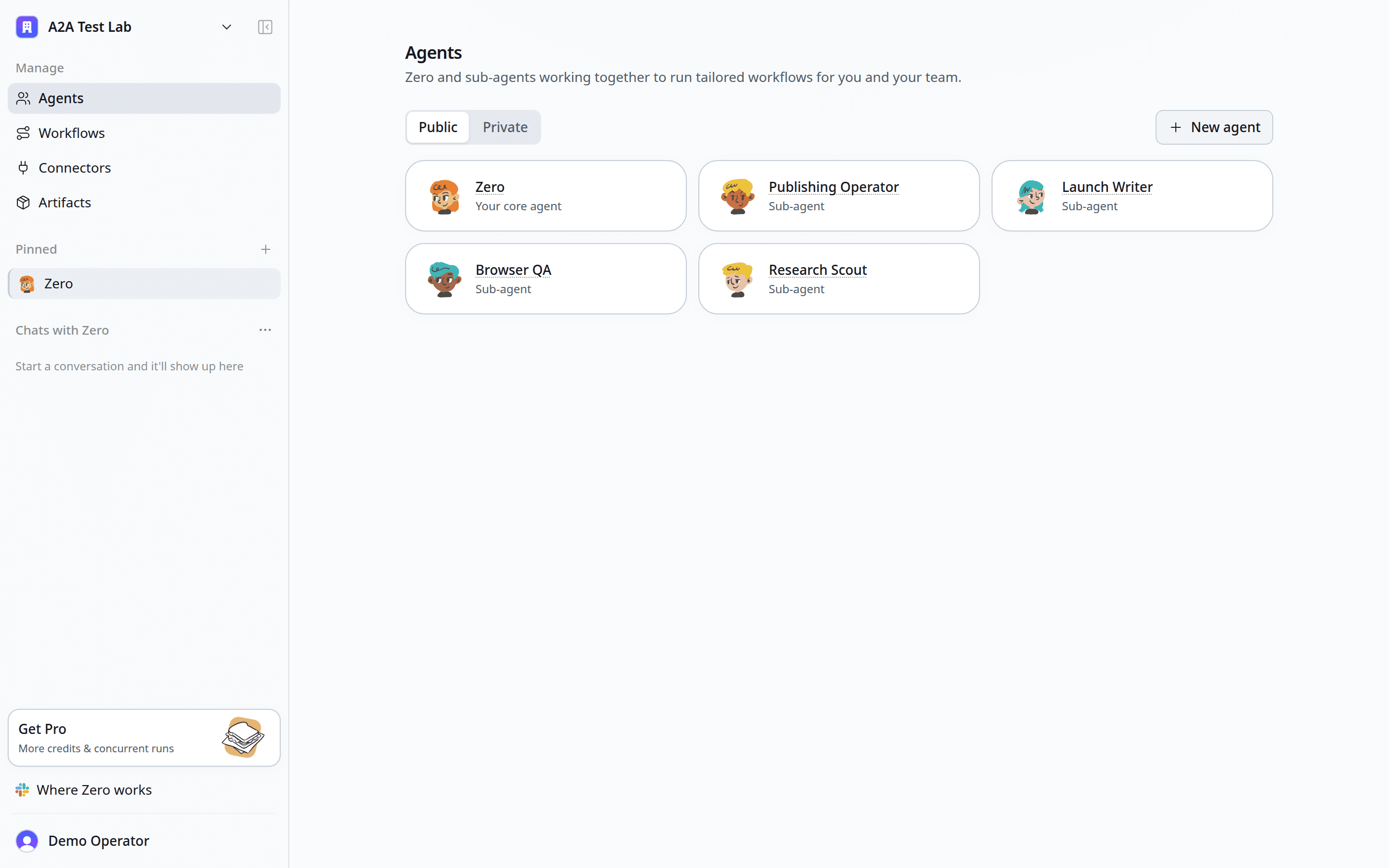
A public Zero agent and role-specific agents give the team a shared starting point without forcing every job into one generic assistant.
2. AI team collaboration needs shared execution across tools
A typical AI handoff creates another handoff. The assistant produces an answer, then a person carries that answer into Gmail, GitHub, Notion, a spreadsheet, or a browser. Context gets copied again. Small decisions disappear along the way.
Zero runs in a cloud computer with access to a browser, files, a terminal, and authorized connectors. It can research a company, compare sources, transform files, draft an email, create a pull request, update a sheet, or publish a report as one connected piece of work.
The collaboration value comes from where that work lands. Zero can deliver the result directly into systems the team already shares: a GitHub pull request, a Notion page, a shared Google Sheet, a Slack thread, or a published report.
That shared workspace is not a new destination your team has to create inside Zero. It already exists across the SaaS products your company uses every day. The cloud browser lets Zero work through their web interfaces. More than 2,000 connectors and APIs give it structured access to the same systems. The sandbox keeps files and intermediate state together while the job is being completed.
Together, these capabilities let Zero carry a task from research to action without asking a person to copy the output between tools. The practical unit of collaboration becomes a deliverable inside a system the team already shares. Engineers can review the pull request, stakeholders can comment on the Notion page, operators can work from the shared Sheet, and the team can resolve the next step in Slack. Each review, edit, and decision stays attached to the shared artifact instead of being copied through another handoff.
This changes the role of the person receiving the handoff. They spend less time rebuilding the execution path and more time judging whether the output is useful, accurate, and ready to move forward.
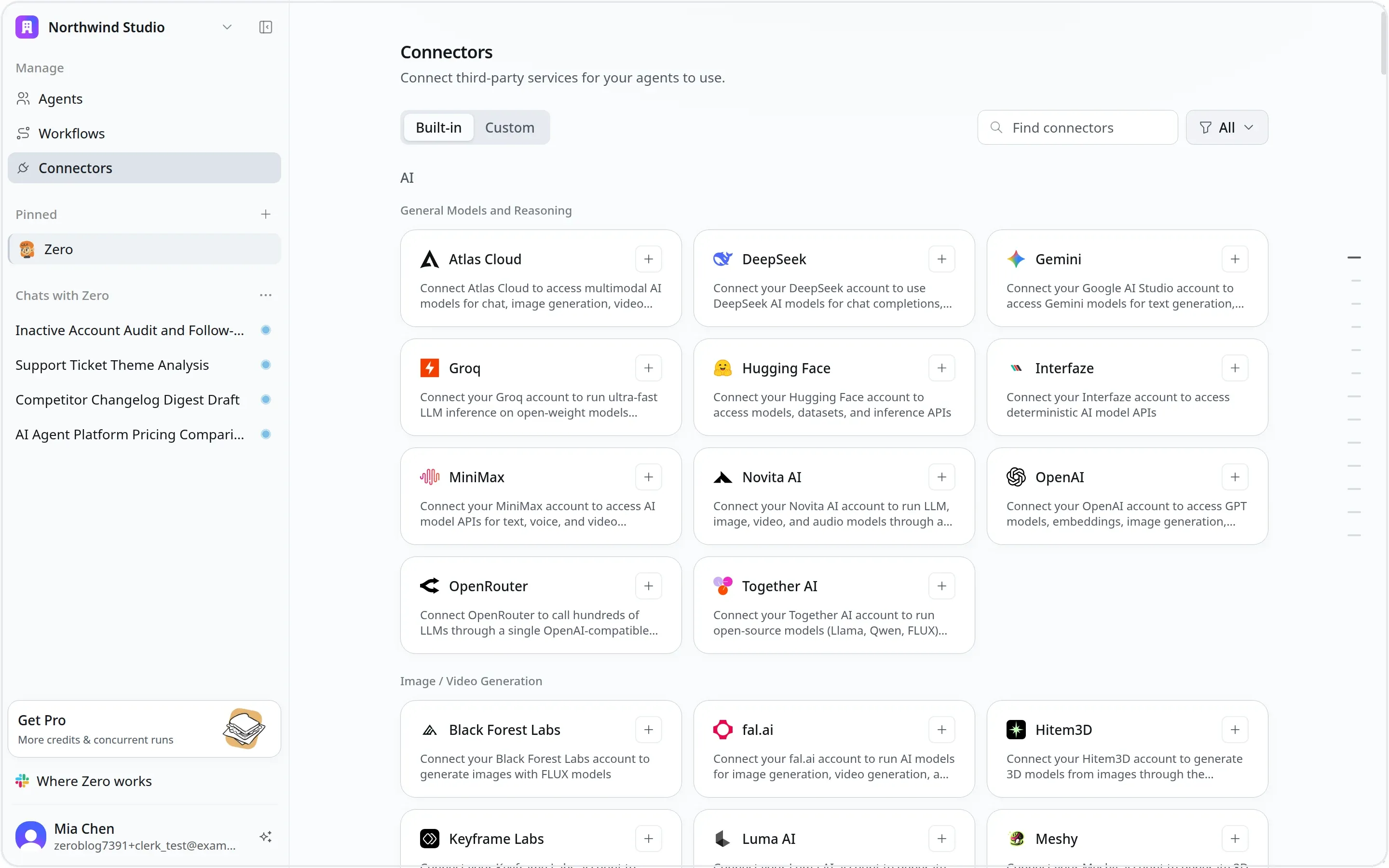
Zero's 2,000+ connectors turn the SaaS stack a team already shares into the collaboration surface.
3. Complex work needs high-quality data and an execution harness
A complex task rarely fails because the prompt was too short. It fails because the inputs were weak or the execution broke halfway. A market-entry decision may depend on current company data, search demand, competitor activity, hiring signals, customer history, and internal product usage. No single teammate or system holds the complete picture. If different people are working from different versions of those facts, more messages will not create alignment.
Zero does not rely only on whatever data already happens to be in the team's SaaS stack. It includes high-quality data APIs for web research, company and people data, social activity, search and SEO, financial markets, maps, weather, and other specialist sources. Zero can query those sources inside the task, combine them with data from the team's CRM, inbox, documents, code, and files, compare conflicting results, and keep the source attached to the claim. The result is evidence the team can use, not a list of links someone still has to research.
Access to good data is only half of the product problem. A model can produce a plausible market report after one search. A complex-task product has to inspect several markets, retain working files, revisit an uncertain claim, recover when a query fails, delegate verification, and deliver a report another person can audit. That requires an engineering harness around the model: an isolated cloud computer, browser, terminal, file system, connectors, permission controls, long-running state, parallel agent threads, and a reliable way to deliver artifacts into the team's tools.
4. Precise feedback loops keep people and agents aligned
Feedback only helps when the next person or agent knows what is wrong and what should change. “Make it better” creates another round of interpretation. “Exclude companies under 50 employees and cite every factual claim” gives the recipient something they can act on. This applies to human-to-AI and human-to-human collaboration alike: feedback loses value when it is separated from the work it refers to.
Zero's Quote action anchors a correction to the exact sentence, claim, or recommendation under review. A reviewer can quote “Acme has 240 employees” and ask Zero to verify the source, or mark several passages at once. The next turn receives each comment with its object intact.

Quote anchors feedback to the exact passage under review, so the next instruction carries its object with it.
Precise feedback also needs to reach the right contributor. With Zero's Agent-to-Agent capability, or A2A, a research thread can verify the claim, an analyst can challenge the numbers, and a writing thread can revise the narrative. They can work in parallel and return the result to the coordinating chat.

A thread mention routes the issue and its context to another agent chat, where the work can continue independently and report back.
Together, Quote and A2A create a clear loop: identify the issue, route it with context, return a correction, and review the result. People spend less time restating comments, while agents receive instructions they can act on.
If repeated feedback reveals a better method, a person can choose to update the Workflow. That step is deliberate. Feedback improves the current collaboration first; it becomes reusable only when the team decides it should shape future work.
5. Workflows turn agreement into executable team capacity
Teams already store procedures in documents. The problem appears when the procedure has to be run.
A document can say, “Research the account, check the CRM, look for recent hiring signals, and draft a personalized reply.” The operator still has to translate each sentence into actions, choose the right tools, and assemble the final output.
A Workflow in Zero is a trigger-free, reusable way to perform a job. It can define the sources to check, the sequence to follow, the constraints to respect, and the shape of the deliverable. A teammate can run it on demand. Another Shared Agent can use a copy adapted to its role.
That makes a Workflow more than a saved prompt. It is an executable agreement about how the team wants a recurring job done.
One person can refine a weekly competitor scan until it meets the company’s standard. The next person does not need to watch a recording, decode an old thread, or ask for the “real” version of the process. They can run the agreed method, review the result, and improve it when the business changes.
The compounding effect comes from reuse. Every verified Workflow increases what the team can do without rebuilding the method from scratch.
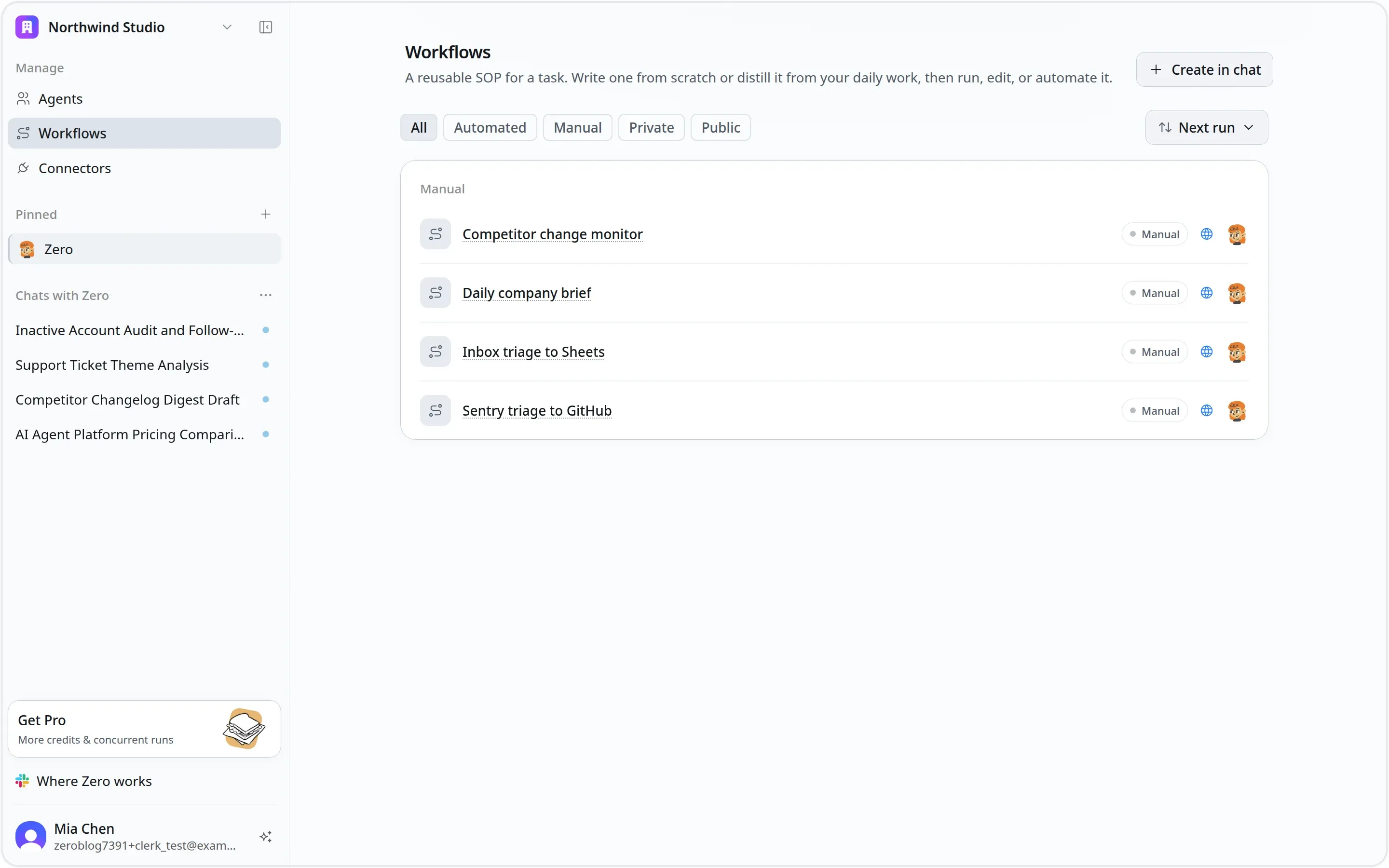
A Workflow turns an agreed method into a reusable way to perform the job, so the next teammate starts with more than instructions in a document.
6. Shared methods can coexist with personal authority
Team collaboration becomes risky when sharing a process also means sharing credentials or removing individual accountability.
Zero separates the reusable method from the conditions that start it. A Workflow holds the procedure. An Automation combines a trigger, a Workflow, and an Agent, then runs within the identity, permissions, and connected services of the person who created it.
The distinction solves a practical governance problem. A sales team can share the same account-research Workflow while each rep uses their own Gmail access. A finance lead can allow an Agent to read one system without authorizing a sensitive write action. An admin can use team workspace controls to decide which connectors and actions are available while individual team members remain responsible for the automations they create.
The team gains consistency without collapsing everyone into one account. The method is shared. Authority remains attributable.
7. Automations let work continue without everyone being present
Many collaboration habits are synchronization habits in disguise. Someone posts a status request. Three people gather updates. A fourth person builds the report. Everyone waits for the same moment to be available.
An Automation gives a shared Workflow a trigger. It can start on a schedule or when an event happens, then ask the selected Agent to complete the job. A morning brief can collect calendar, product, support, and engineering signals before standup. A new customer email can start a research and drafting flow. A weekly competitor review can arrive in the team channel with sources attached.
The value is larger than saved time. Work can advance while the team is in meetings, asleep, or focused elsewhere. People reconnect around a concrete artifact rather than another request for updates.
Asynchronous collaboration works when the output is predictable enough to trust and inspect. That is why the shared Workflow, human review standard, and permission model matter. Automating an unclear process only creates unclear work more frequently.
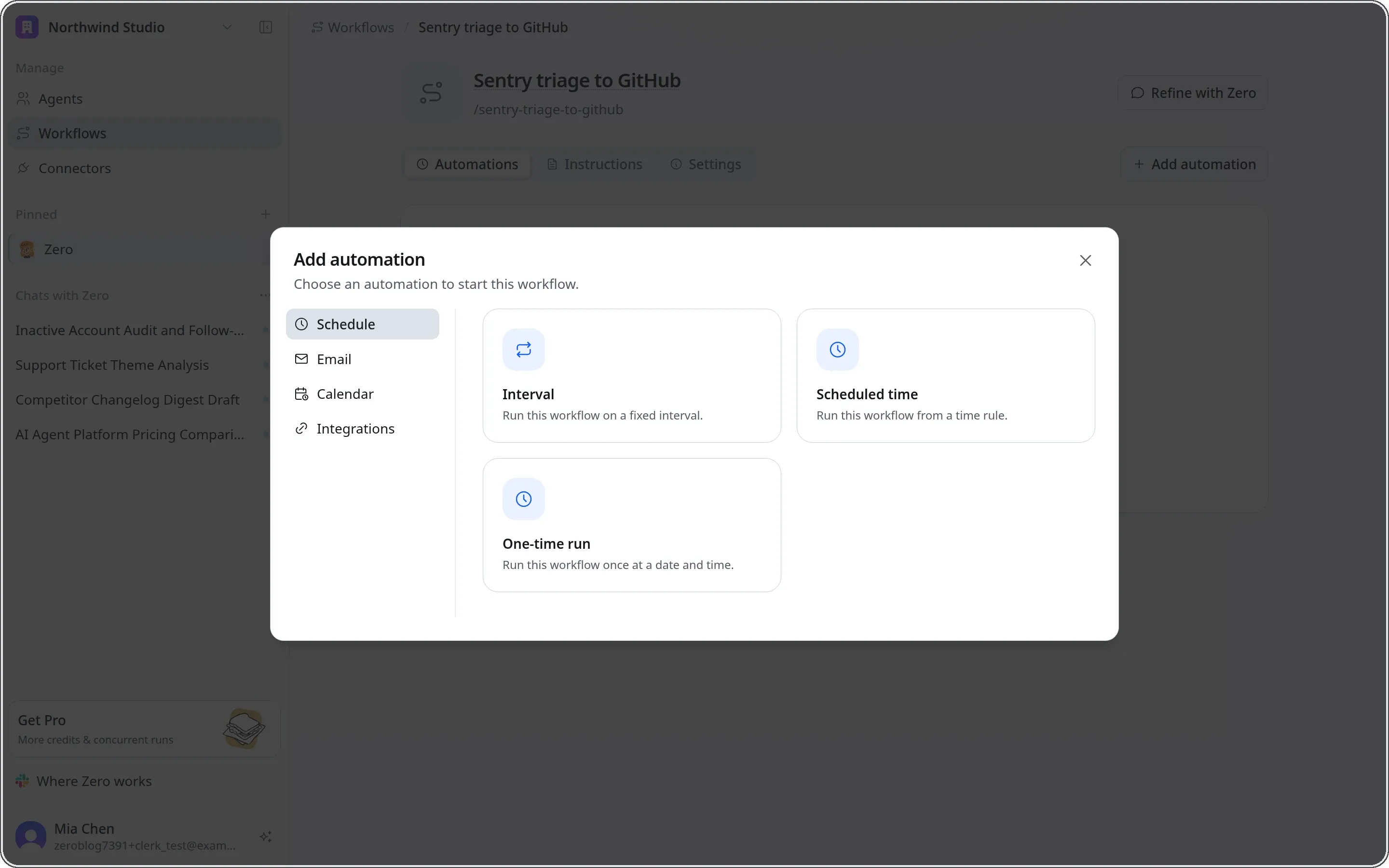
An Automation attaches a schedule or event trigger to a Workflow, so recurring work can start without waiting for someone to prompt it.
One lead, one collaboration loop
Return to the lead that arrived Monday morning.
The team’s Shared Agent already has the ICP, approved positioning, and research rules. A rep runs the lead-qualification Workflow. Zero reads the inbound email, researches the company through the browser and connected sources, checks the required criteria, and creates an account brief with a reply draft.
The sales lead reviews it and spots a weak assumption. She asks Zero to exclude unsupported employee estimates, cite the source for each qualification claim, and open with a use case tied to the prospect’s current product. Zero redoes the brief and updates the draft.
The team decides those changes should apply to future leads, so the Workflow is edited. Another rep can now run the improved version. Each rep can create a personal Automation for new inbound emails, using their own credentials and permissions.
The email draft is useful. The larger gain is that the handoff improved the team’s repeatable ability to handle the next lead.
This is more than traditional automation
The obvious objection is that companies have automated workflows for years. That is true, and stable, rules-based automation remains the right answer for many processes.
Collaborative work is often less settled. Inputs are messy. The path changes after research begins. Quality depends on judgment that people have never written down. A manager may know a weak account brief on sight but struggle to express the full standard before seeing a first draft.
Zero lets the team begin with the job in natural language, inspect a real deliverable, and make the method more explicit through review. Once the process is stable enough, the team can preserve it as a Workflow and decide whether it should run through an Automation.
There are limits. Zero does not remove the need for ownership, review, or hard conversations. Creative direction, strategic tradeoffs, and sensitive approvals still belong to people. It also should not claim to learn the company automatically from every interaction. Today, the durable learning step is intentional: a person saves or edits the Workflow.
Those limits are part of the design. Good team collaboration needs clear human judgment and clear machine responsibility.
The new unit of AI team collaboration is an executable standard
Messages help people talk. Documents help people remember. Tasks help people track responsibility. Zero adds a unit that teams have been missing: a standard that can perform the work.
This changes how a team can evaluate collaboration software. Ask:
- Does the next person inherit the context, or reconstruct it?
- Can the system carry out the method across the required tools?
- Can human feedback become an explicit, reviewable standard?
- Can the method be reused without sharing someone else’s identity?
- Can the work continue when nobody is present to push it forward?
If the answer is yes, collaboration begins to compound. A completed job leaves behind more than an artifact. It leaves the team better prepared to do the job again.
Start with one recurring handoff: a weekly brief, an inbound lead, a support escalation, or a release report. Give it a clear deliverable, a named reviewer, and access to the systems it needs. Run it once with Zero. Review the work. Save the method that survives.
The goal is simple: each time work crosses a handoff, less intent should be lost.


